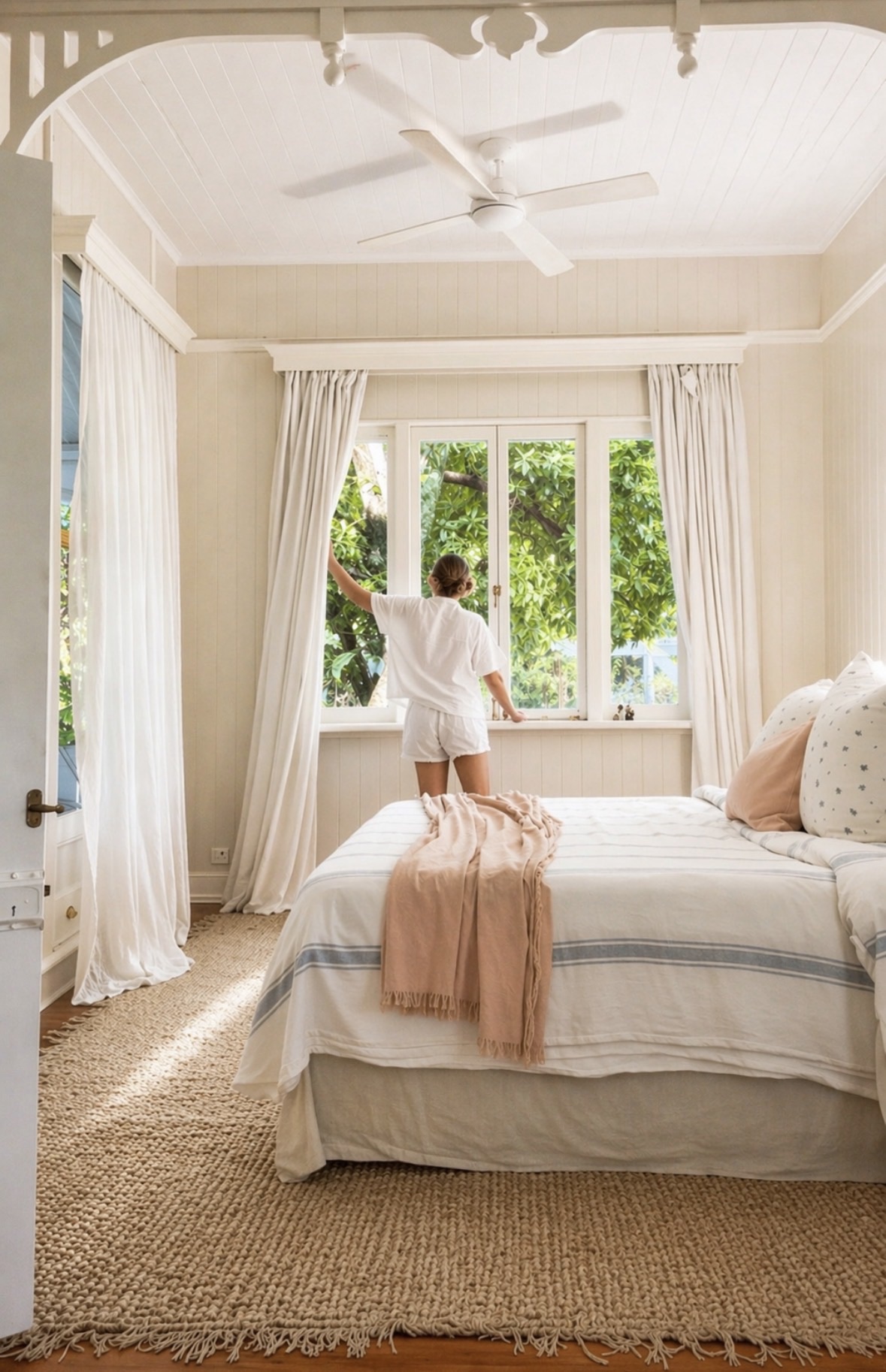
Simple evening habits that shift the feeling of your home
INTRODUCTION
The way a home feels at night is different to any other time of day.
It’s when everything begins to slow.
When the movement of the day settles.
When your home either continues to feel busy…
or starts to feel calm.
This doesn’t happen by chance.
A calm evening is created through small, intentional shifts —
not more effort, but a change in how the home is experienced.
WHY EVENINGS OFTEN STILL FEEL BUSY
For many homes, the pace of the day carries straight into the evening.
Lights stay bright.
Spaces remain open and active.
There is no clear transition from day to night.
Even when everything is done, the home can still feel unsettled.
Not because anything is wrong —
but because the environment hasn’t shifted.
A calm evening begins with creating that shift.
1. LOWER THE LIGHT
Light is one of the most powerful ways to change how a home feels.
During the day, brighter light supports movement and activity.
In the evening, it keeps the home feeling alert.
A simple shift softens everything immediately.
Turn off overhead lights where possible.
Use lamps instead.
Allow the room to hold a warmer, more contained light.
This signals, without effort, that the day is coming to a close.
2. CLOSE THE DAY PHYSICALLY
Small physical actions create a sense of completion.
Closing the curtains is one of the simplest and most effective.
It changes the feeling of the space immediately —
from open and outward, to contained and settled.
It creates a boundary between the outside world and your home.
Other small actions can do the same:
- clearing one surface
- putting away a few things
- closing a door
These are not tasks.
They are signals.
3. SHIFT INTO COMFORT
What you wear and how you move at home in the evening matters more than it seems.
Changing into something comfortable —
soft, natural fabrics, well-made pieces you actually enjoy wearing —
creates a subtle but noticeable shift.
It marks the end of the day in a way that feels intentional, not rushed.
Taking your hair out, loosening the structure of the day,
allowing yourself to move more slowly within the space.
These small transitions change how you experience your home.
4. CREATE A QUIET MOMENT FOR YOURSELF
A calm evening doesn’t require a long routine.
Often, one quiet moment is enough.
A bath.
A few minutes of skincare.
A simple gua sha ritual.
Sitting with a tea.
Not as another task to complete,
but as a pause you return to.
A way to step out of the pace of the day,
even briefly.
5. REDUCE MOVEMENT
Evenings don’t need to be completely still,
but reducing unnecessary movement makes a difference.
Moving more slowly between spaces.
Finishing one thing before starting another.
Allowing moments to exist without filling them.
This shifts the rhythm of the home from active to settled.
6. LET THE HOME SUPPORT YOU
A calm home at night is not something you maintain perfectly.
It’s something that begins to happen naturally
when the environment supports it.
When the light is softer.
When the space feels more contained.
When the pace slows.
You don’t need to do more.
You need less resistance from the space around you.
A SIMPLE EVENING RESET
If you want something practical to return to:
- Turn off overhead lights
- Close the curtains
- Change into something comfortable
- Clear one surface
- Take a moment for yourself
That’s enough.
FINAL NOTE
A calm evening is not created through a long routine.
It is created through a shift.
A shift in light.
A shift in pace.
A shift in how your home holds the end of the day.
Over time, this becomes something you return to —
and something your home begins to offer you naturally.
IF YOU WANT TO GO FURTHER
If you want a more complete approach to creating a calm, beautiful home,
you can explore The Calm, Beautiful Home.
Or, if you’re navigating this with children,
Raising Children in a Slow Living Home expands on how daily life fits within it.
Leave a Reply